
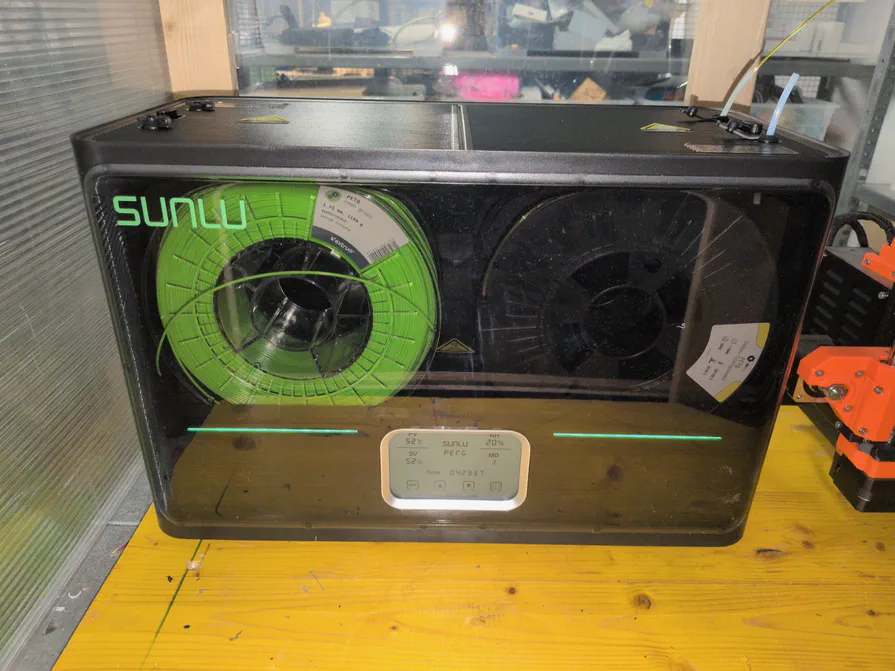
New in our 3D printing corner: a Sunlu FilaDryer S4. The filament dryer brings damp filament back into shape and keeps it dry while you print.
Why dry filament?
Most filaments pull moisture out of the air. You can’t see it on a spool, but you notice it when printing: the nozzle crackles and hisses as the water boils off in the hotend, you get stringing and bubbles, the surface turns rough and the layers don’t bond as well. Nylon (PA), TPU, PETG and PC are particularly sensitive, but even PLA that’s been lying around open for a while prints noticeably better once it’s dried.
Lots of people share the spools at our place, and not every one goes straight back into its bag after a print. So a dryer had been on the wish list for a long time.
What the FilaDryer S4 can do
- Four spools at once: The chamber holds up to four 1 kg spools, with 1.75 mm, 2.85 mm or 3.0 mm filament.
- Up to 70 °C: The temperature can be set between 35 °C and 70 °C, and according to Sunlu it’s held within ±3 °C. That’s enough for more demanding materials such as nylon or PC too.
- Even heat: A PTC heater with a fan at the bottom and two side fans spread the warm air through the whole chamber, so all four spools dry evenly.
- Profiles for common materials: There are ready-made drying profiles for PLA, PETG, ABS, TPU, PC and PA. You can also set temperature and duration yourself.
- Humidity automation: A sensor measures the humidity in the chamber and shows it on the display. In automatic mode the dryer starts by itself as soon as a set value between 30 % and 50 % is exceeded, and stops again at 25 %. That turns it into a dry storage box for opened spools.
- Printing straight from the dryer: PTFE outlets run the filament directly to the printer while it’s kept dry, for up to four printers at once.
- Safety: On top of the software monitoring, a mechanical temperature switch cuts out if something goes wrong.
What we use it for
- Rescuing spools: Filament that crackles or strings goes into the dryer for a few hours before printing.
- Long prints: For prints that run overnight or over several days, on the Prusa XL for example, the filament can be drawn straight from the dryer and picks up no moisture along the way.
- Engineering filaments: Nylon, TPU and PC really only print cleanly when dry. With the S4 it’s worth giving these materials a go.
- Storage: In humidity mode, opened spools stay dry between prints.
Want to print with your own filament that’s been lying around for a while? Bring it along to one of our open evenings, Tuesdays and Fridays from 19:30. There’s more about our printers on the 3D printing page.