
When 3D printing with the B9Creator, UV resin is cured layer by layer with the help of a projector and so turned into a shape, which is lifted out of the remaining still-liquid resin after the print. So that the resin does not bond with the acrylic glass print tray (called the vat in the manuals) as it cures, a coating of silicone (PDMS) is used. Unfortunately this breaks down after a few prints and therefore has to be renewed regularly.
We settled on silicone of the brand Wacker Elastosil 601 with Shore hardness 45. Unlike the Sylgard 184 used originally, it is available locally and even has slightly better adhesion to the acrylic glass of the print tray. We shall see, and report, how it behaves in terms of durability during 3D prints.
To repair the PDMS coating successfully with the Elastosil, it is best to use a levelling table. If you do not have one to hand, the do-it-yourself variant works excellently: put a spirit level on a plate with three levelling screws and any unevenness is quickly compensated for.
For mixing the silicone a letter scale is recommended, since you have to mix two components of 45 g and 5 g respectively. A scale accurate to 1 g may produce an error of 10% at a quantity of 5 g, since you never learn whether there are 4.5 g or 5.4 g in the cup. Letter scales show tenths of a gram and therefore do not have this problem. With letter scales and measuring cups such a mixing ratio should be easy to achieve.
Since UV resin printing is an optical process, in which the object is irradiated with UV light from below, it is important that the silicone contains as few air bubbles as possible, since they can deflect and disturb the light rays. The Elastosil we use has a high viscosity and therefore does not really need to be degassed separately, provided the mixing ratio above is accurate enough. Any bubbles rise on their own and burst at the surface.
If you heat the vat to a maximum of 70 °C to cure the silicone, it can be used again after just 3–4 hours. That does however increase the risk that not all the air bubbles in the silicone reach the surface before it has finished curing. Without heat, curing the silicone takes up to 48 hours, which does make the silicone more likely to be free of bubbles. It is therefore worth working with a second vat, so the B9Creator can be kept in operation.
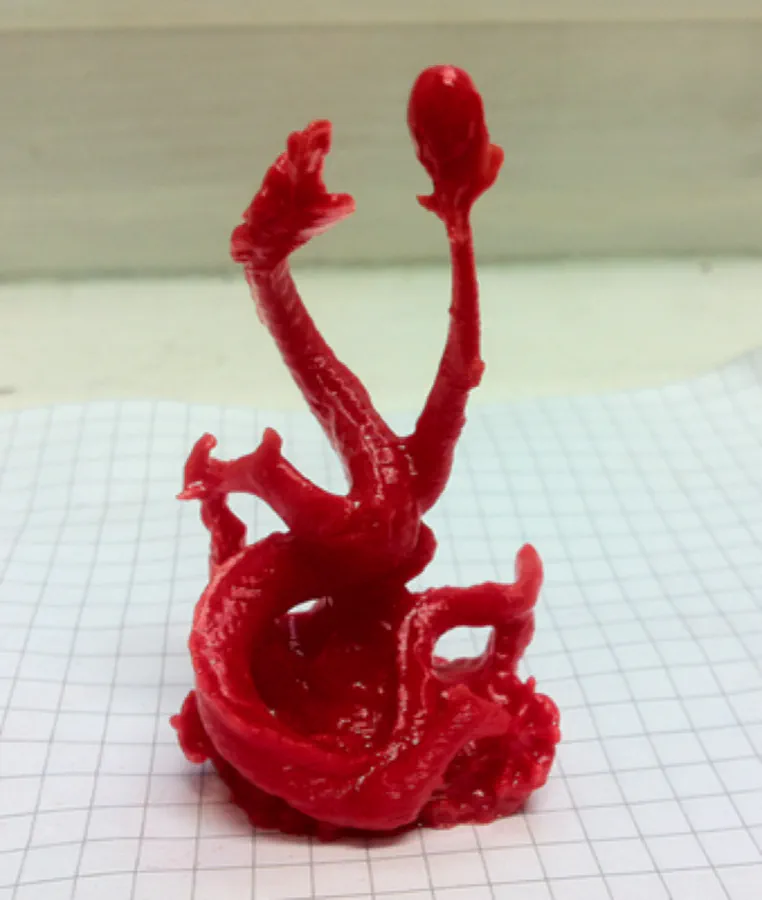
As a test we printed the dragon by artec3d on Thingiverse. Because of mistakenly different Z-axis settings in the slicer and the printing program, it came out stretched. Astonishingly, the print result is still presentable. 100 microns of the original object correspond to 88.5 microns in the print shown above.